Merge Mining (Merged Mining)
10/04/2026
Merge mining (also known as Auxiliary Proof of Work, or AuxPoW) is a technology that allows a miner to simultaneously mine blocks on multiple blockchains using the same hardware, with zero additional energy expenditure.
Put simply: you do the exact same amount of computation as before, but collect rewards from two (or more) networks at once.
Comparison: Merge Mining vs. Standard Mining
| Parameter | Standard Mining | Merge Mining |
|---|---|---|
| Energy consumption | Baseline | Unchanged |
| Reward count | 1 coin | 2+ coins |
| Hardware | 1 device → 1 network | 1 device → multiple networks |
| Setup complexity | Standard | Requires pool support |
| Profitability | Baseline | from +5% to +95% |
How to Start Merge Mining on Kryptex Pool
Kryptex Pool supports merge mining automatically — no extra configuration needed. Connect to the pool using your wallet address and start collecting rewards from multiple networks at once.
👉 Start Merge Mining BTC + FB (SHA256)
- Global:
stratum+tcp://btc.kryptex.network:7014 - Europe:
stratum+tcp://btc-eu.kryptex.network:7014 - North America:
stratum+tcp://btc-us.kryptex.network:7014 - Singapore:
stratum+tcp://btc-sg.kryptex.network:7014 - Hong Kong:
stratum+tcp://btc-hk.kryptex.network:7014 - Russia:
stratum+tcp://btc-ru.kryptex.network:7014
👉 Start Merge Mining LTC + DOGE + 8 Altcoins (Scrypt)
- Global:
stratum+tcp://ltc.kryptex.network:7016 - Europe:
stratum+tcp://ltc-eu.kryptex.network:7016 - North America:
stratum+tcp://ltc-us.kryptex.network:7016 - Singapore:
stratum+tcp://ltc-sg.kryptex.network:7016 - Hong Kong:
stratum+tcp://ltc-hk.kryptex.network:7016 - Russia:
stratum+tcp://ltc-ru.kryptex.network:7016
Connection format: WALLET.WORKER
More info: pool.kryptex.com
A Brief History
| Year | Event |
|---|---|
| 2009 | Bitcoin launches. SHA-256 becomes the first PoW algorithm |
| Sept. 19, 2011 | Namecoin — the first altcoin built on Bitcoin's codebase — introduces merge mining (block #19,200). The first AuxPoW block ever mined |
| April 2014 | Charlie Lee (Litecoin creator) proposes merging LTC and DOGE mining for mutual security |
| Sept. 2014 | Dogecoin hard forks to implement AuxPoW. Network hashrate surges +1,500% within one month |
| 2014 | Syscoin launches merge mining with Bitcoin |
| 2018 | Rootstock (RSK) brings EVM-compatible smart contracts to Bitcoin via merged mining. Today attracts 100+ EH/s from Bitcoin miners |
| 2018–2020 | Elastos, Hathor, and others adopt AuxPoW with Bitcoin |
| 2022 | Syscoin joins the Merge Mining Alliance |
| Sept. 2024 | Fractal Bitcoin (FB) mainnet launches with merge mining support. ~40% of global Bitcoin hashrate mines FB from day one. Uses "Cadence Mining": out of every 3 FB blocks, one is mined via AuxPoW (merged with BTC); the other two use standard FB PoW |
How Merge Mining Works
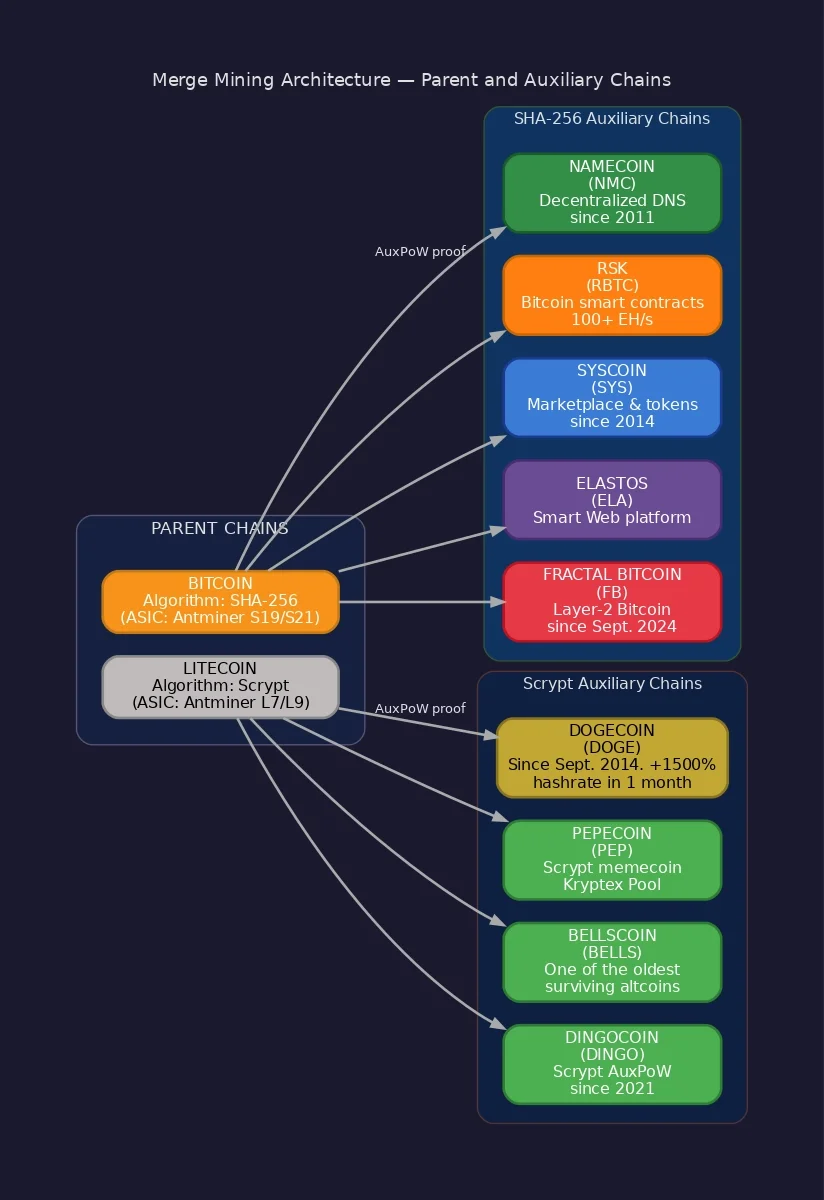
Two Blockchain Roles: Parent and Auxiliary
In any merge mining setup, there are always two participants:
| Role | Name | Description | Examples |
|---|---|---|---|
| 🏠 Primary | Parent Chain | The network where the miner performs actual computations. Requires no changes: Bitcoin nodes process their blocks as usual; AuxPoW data embedded in the coinbase is completely transparent to them | Bitcoin, Litecoin |
| 🔗 Secondary | Auxiliary Chain | The network that accepts proof of work from the parent chain. Must explicitly support AuxPoW | Fractal Bitcoin, Namecoin, Dogecoin, RSK |
⚠️ Key requirement: both chains must use the same hashing algorithm (SHA-256, Scrypt, etc.)
Technical Mechanism: From Theory to Bytes
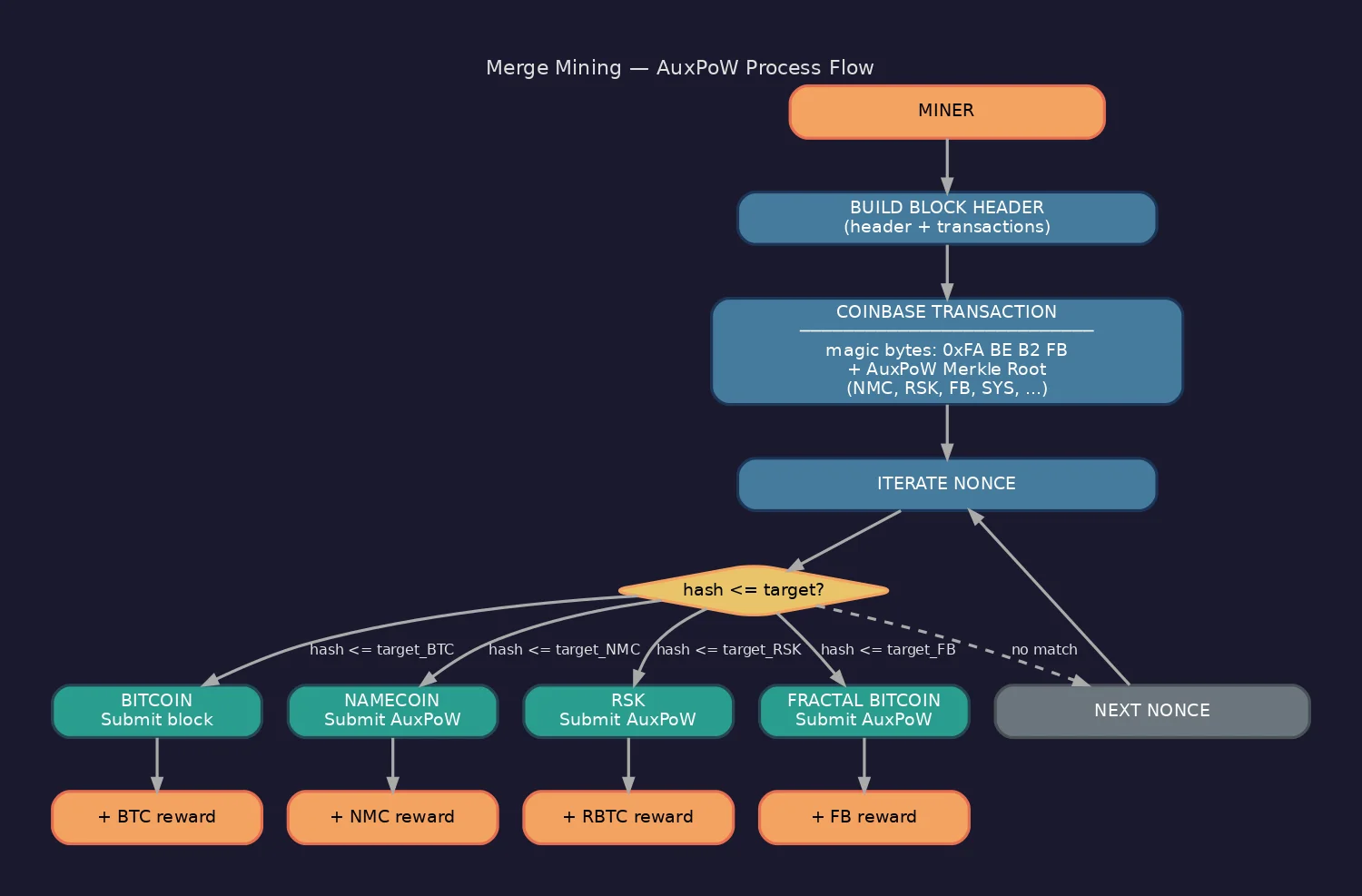
Step 1. The Coinbase Transaction with "Magic Bytes"
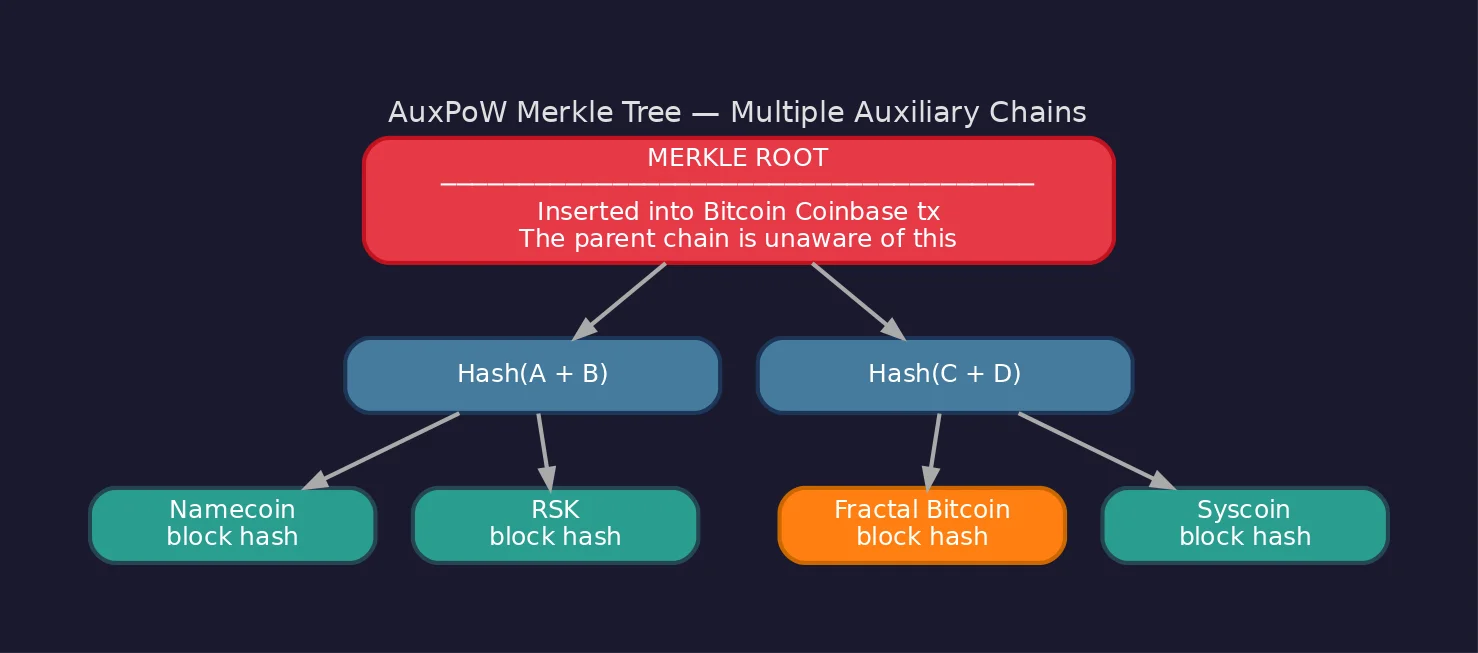
Every Bitcoin block contains a special transaction — the coinbase (the first transaction in a block, which mints new coins). Its scriptSig field holds up to 100 bytes of arbitrary data (AuxPoW data takes up only ~44 of them: 32 bytes for the Merkle root + 4 magic bytes + auxiliary fields — well within the limit). This is where the miner embeds the Merkle root of auxiliary chains — a cryptographic fingerprint of all AuxPoW blockchains being mined in parallel.
Preceding it are 4 "magic bytes" (0xFA BE B2 FB) that signal the presence of an AuxPoW record to supporting nodes.
Step 2. Merkle Tree of Auxiliary Blocks
If a miner is simultaneously mining multiple auxiliary chains, their block hashes are organized into a Merkle tree.
💡 What is a Merkle tree? Think of a tournament bracket: the hashes of four coins (NMC, RSK, FB, SYS) are paired up, each pair is hashed together, those results are hashed again — producing one Merkle root. If even a single original hash changes, the root changes completely. The key advantage: to prove that Fractal Bitcoin's hash was included in the work, the miner only needs to share 2–3 "sibling" hashes along the path to the root — not all the data.
Step 3. Mining the Nonce
The nonce (short for number used once) is a numeric field in the block header. The miner iterates through it billions of times per second, looking for a hash that meets the network's target difficulty. The key insight: the same Bitcoin block header — which already contains the AuxPoW Merkle root in its coinbase — is used to search for the nonce. No separate computation is needed.
Once a valid nonce is found:
- For Bitcoin: the block is immediately broadcast to the BTC network.
- For auxiliary chains: if the hash also satisfies their (lower) difficulty target, the miner assembles an AuxPoW proof packet.
Step 4. The AuxPoW Proof Packet
The auxiliary node (e.g., Namecoin) receives the following packet for verification:
| Component | Description |
|---|---|
| Coinbase transaction | Contains the Merkle root with magic bytes |
| Merkle path to coinbase | Proves the coinbase is included in the Bitcoin block |
| Bitcoin block header | With the valid nonce satisfying the difficulty target |
| Merkle path in the AuxPoW tree | Proves that this specific auxiliary chain's hash is part of the root |
The Namecoin node verifies the entire chain and accepts the block — without a single additional hash computation on the miner's part.
Popular Merge Mining Pairs
SHA-256: Bitcoin + Auxiliary Chains
| Coin | Ticker | Description |
|---|---|---|
| Namecoin | NMC | The first AuxPoW coin. Decentralized DNS and digital identities on top of Bitcoin |
| Rootstock | RSK | EVM-compatible smart contract network on top of Bitcoin. Today attracts 100+ EH/s from BTC miners |
| Fractal Bitcoin | FB | Bitcoin Layer-2. "Cadence Mining": every 3rd block via AuxPoW. ~40% of global BTC hashrate |
| Syscoin | SYS | Layer-1/Layer-2 platform with asset support and smart contracts |
Scrypt: Litecoin + Auxiliary Chains
| Coin | Ticker | Description |
|---|---|---|
| Dogecoin | DOGE | The largest Scrypt AuxPoW coin. Hashrate surged +1,500% within the first month after AuxPoW was implemented |
| Pepecoin | PEP | Scrypt meme coin with a digital art collector community |
| Bellscoin | BELLS | One of the oldest altcoin networks running on Scrypt AuxPoW |
| Dingocoin | DINGO | Scrypt AuxPoW coin with an active DeFi community |
Advantages of Merge Mining
For miners:
- Extra income at no cost — same hashrate, more rewards. Typical income boost: 5–20% depending on the coin.
- Zero additional operating costs — no extra electricity, hardware, or separate worker required.
- Diversification — reduces dependency on the price of any single coin.
For networks:
- Security — auxiliary chains inherit the enormous hashrate of the parent network. A 51% attack becomes practically impossible.
- Decentralization — attracts miners without needing to create a separate competitive market.
Risks and Limitations
- Hashrate centralization — large pools can simultaneously control multiple networks. That's why decentralization of hashrate across the network is so important.
- Attack incentives — in theory, a miner with a large hashrate could attempt a double-spend on a weak auxiliary network at lower cost than on the main chain.
- Setup complexity — requires AuxPoW support from your pool; not all pools provide it.
- Algorithm dependency — only chains using the same hashing algorithm can be merged.
Conclusion
Merge mining is one of the few technologies in the crypto industry where everyone wins: miners earn more income at no extra cost, and auxiliary networks gain robust security.
Need Help?
Have any questions, something is unclear, or you can't connect? Contact support — we're happy to assist!
Email support at support@kryptex.com
